
Retiring Rigs: How a Mixed Fleet Decides What Stays
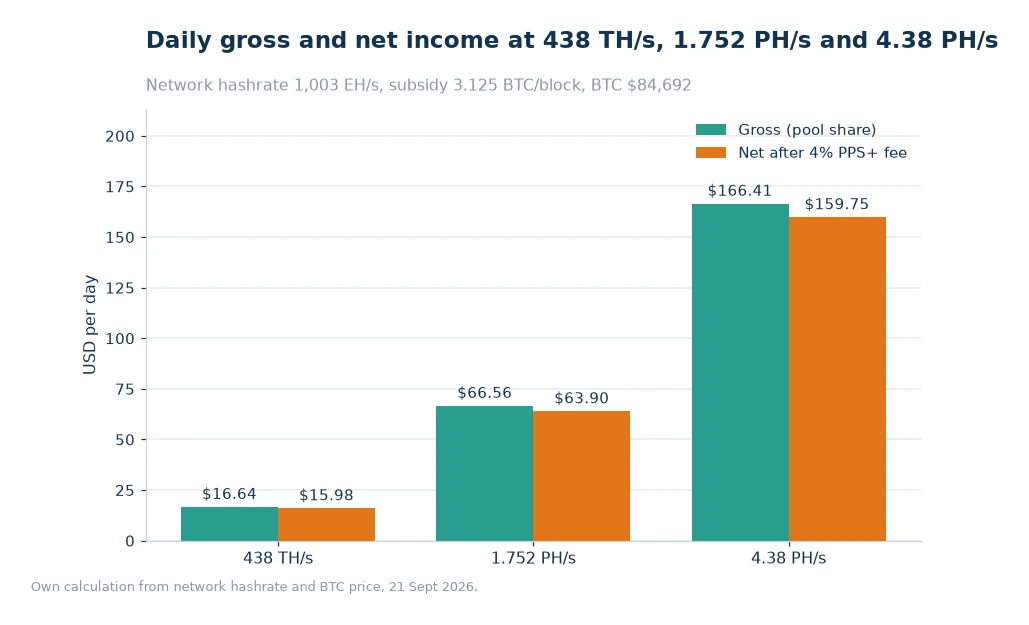
Every farm eventually owns machines that are still working and no longer earning their space. At 438 TH/s a current unit brings in 0.00019649 BTC a day, about $16.64 gross and $15.98 after the listed 4% on the block-reward component. Multiply that by the racks in a mixed fleet and the retirement question becomes a spreadsheet problem rather than an emotional one.
Key takeaways
- One 438 TH/s unit nets $15.98 a day at BTC $84,692; four make 1.752 PH/s and ten make 4.38 PH/s.
- Retirement should be triggered by net per rack unit, not by the age printed on the case.
- A machine that is offline 10% of the time loses about $48 a month at the 438 TH/s rate.
- Power contracts and rack leases usually run longer than hardware, so the exit cost belongs in the model.
Which machines earn their rack space
A rack slot is a finite resource with a cost attached: power capacity, cooling capacity, a network port and the physical space. A machine that produces less than the slot's alternative use is a candidate for removal even if it technically runs. The comparison is not against zero, it is against the best use of that slot, which might be a newer unit, a different coin, or simply leaving the space empty and reducing the power bill.
Ranking every unit by net output per slot is the cleanest way to start. A mixed fleet usually has three or four output bands, and the bands matter more than individual serial numbers. Once the bands are visible, a retirement list tends to write itself: the lowest band goes first, unless it has a role that the numbers do not capture, such as holding a spare slot warm for a seasonal peak.
Grouping a fleet by output band
Grouping is mostly exercise in honest measurement. Take the last thirty days of pool credits per worker, divide by the days online, and sort the results into bands. Machines that have been repaired, moved or throttled will not sit where their nameplate says, and that is the point. A unit that is 8% below its band is a maintenance ticket; a unit that is 30% below is a retirement candidate.
The ViaBTC Miner Ranking is useful here as an external reference. If a model sits low on the list at current difficulty, the whole band is unlikely to justify a large repair, and the decision can be made at the model level rather than machine by machine. If the model still ranks reasonably, the problem is likely local and worth fixing.
The replacement math for an older unit
Replacing a unit is not the same as retiring one. The new machine has a purchase price, a lead time and a different efficiency, and it may need a different power connector or firmware. A simple test is to compare the net of the old unit with the net of the new one, then divide the price difference by the daily gain. The result is the number of days before the upgrade pays for itself, which is the only comparison that matters if the goal is cash flow.
Do not compare nameplate hashrates. Two units with the same output can differ in watts, and the one that draws less leaves more room under the site's power cap. On a farm that is already at its limit, the relevant gain from a replacement may be the freed capacity rather than the extra hash. That is a different calculation, and it often favours a smaller, more efficient unit over a larger one.
Downtime is a fleet-wide tax
A single machine going offline is a small loss. A cooling failure that takes a row offline is a large one, and the loss is not only the missing credits but also the catch-up work after the restart. At the 438 TH/s rate, ten percent downtime costs about $1.60 a day per unit, or roughly $58 over a month. Across forty units, that is $2,320 a month, which is enough to fund a serious maintenance programme.
The fix is usually unglamorous: spare fans, spare power supplies, a temperature alert, and a rule that no unit sits offline for more than a set number of hours without a decision. Track the reason for each outage in a log. After a quarter, the log will show whether the fleet's problem is heat, power, network or parts, and that tells you where to spend the maintenance budget.
The table groups the chart's three hashrate tiers as units of the same model, which is how a fleet report usually presents them.
| Fleet slice | Units | Combined hashrate | Net per day | Net per unit |
|---|---|---|---|---|
| Single unit | 1 | 438 TH/s | $15.98 | $15.98 |
| Small group | 4 | 1.752 PH/s | $63.90 | $15.98 |
| Full row | 10 | 4.38 PH/s | $159.75 | $15.98 |
Power contracts outlive hardware choices
A mining farm signs a power agreement for years and buys hardware for a shorter horizon. That mismatch is the main reason retirement decisions feel harder than they are. If the site has committed to a minimum draw, removing machines may not reduce the bill at all, and the retired unit's net is lost while the cost stays. In that case the right move may be to keep running until the contract can be renegotiated.
Before retiring anything, read the contract's take-or-pay clause and the notice period. Then model two scenarios: retire now and absorb the fixed cost, or run until the contract's next break point. The second is often better even when the machine is marginal, because a marginal machine that covers its variable cost contributes something toward the fixed bill. The decision flips only when the variable cost, including maintenance, exceeds the net.
A retirement schedule that survives a price drop
Write the schedule as a rule rather than a list. For example: any unit whose thirty-day net falls below the cost of its slot for two consecutive months is retired, unless it is holding a strategic slot. A rule survives a price drop because it triggers on the same inputs regardless of the mood in the room, and it gives the maintenance team a predictable workload.
Review the rule once a quarter, not once a week. Difficulty and coin price move constantly, and a weekly review produces churn without information. A quarterly review captures the trend and leaves enough time to sell retired units into a reasonable market rather than dumping them all at once.
Worked example
Build the row from one unit and check the multiplication.
- 438 TH/s × 0.00000044861 BTC per TH/s = 0.00019649 BTC a day.
- 0.00019649 × 84,692 = $16.647, shown as $16.64 gross.
- 96% of $16.647 is $15.98, the net after the listed 4%.
- Four units: 4 × 0.00019649 = 0.00078596 BTC, or $66.56 gross and $63.90 net.
- Ten units: 10 × 0.00019649 = 0.00196489 BTC, or $166.41 gross and $159.75 net.
- Ten percent downtime on one unit: $15.98 × 0.10 = $1.60 a day, or $47.94 over 30 days.
- Across forty units at the same rate, that downtime costs $1,917.60 a month, which is the number the maintenance budget has to beat.
Frequently asked questions
When should a farm retire a working miner?
When its net after power and maintenance falls below the value of the slot it occupies for two consecutive months, or when a repair quote exceeds the net it will earn before the next review.
Is downtime really a large cost?
Yes, at fleet scale. At 438 TH/s a unit loses about $1.60 a day when offline, so forty units at ten percent downtime give up roughly $1,918 a month in credits before any restart labour.
Does an older machine still belong in a ranking?
It can, but read the ranking as a model-level signal. A low position suggests the whole band is weak at current difficulty, while a single underperforming unit in a healthy band is usually a repair rather than a retirement.
Retire on a schedule, not in a panic
Put the rule in writing, review it quarterly, and sell retired units before the market is flooded by everyone else doing the same thing. The Mining Farms listings are a useful reference for what a hosted slot costs, which is the number a retained machine has to beat. For sites that host third-party gear, the Miner Hosting directory shows how the supply side is organised. Neither replaces your own contract, but both sharpen the comparison.
Sources: ViaBTC farms, companies, pricing and hardware pages, used for hosting categories and the component rate. Chain readings on 21 Sept 2026: 1,003 EH/s network hashrate, 3.125 BTC subsidy per block, 144 blocks daily, BTC $84,692. Published 24 Oct 2026. No power, labour or parts costs are included[1].