
Default
How do I know if a Fuel Pump is authentic KEMSO?
·
Nasza Floryda
·huanggs
To verify whether the fuel pump is a genuine KEMSO, it is first necessary to check its packaging and the unique traceability code on the pump body surface. KEMSO assigns a unique 18-digit alphanumeric serial number to each product, such as "KFP230819-CN7842". By entering this code through the verification portal on the KEMSO official website, the system immediately returns product information, including the production date (such as August 2023), the designated production line (Line CN-3), and the corresponding factory inspection report number. According to statistics, products with serial numbers that have not passed the official verification channels or display incomplete information have a probability of being counterfeits that exceeds 85%. During the special anti-counterfeiting operation in the Southeast Asian market in 2022, 92% of the serial numbers of the counterfeit fuel pumps seized by law enforcement agencies were forged or reused.
Secondly, it is of vital importance to detect the matching degree between its operating parameters and the nominal specifications. Under standard operating conditions (system pressure 3.5bar, fuel temperature 40℃), the flow output error of genuine KEMSO fuel pumps is strictly controlled within ±2% (for example, for a model with a nominal flow rate of 150L/h, the measured value is stable at 147-153L/h). The pressure curve was detected by a dedicated test bench. Under the rated voltage of 13.5V, the start-up time should be less than 350 milliseconds, the pressure establishment period should complete the peak within 0.5 seconds, and the peak-to-peak value of the pressure pulsation amplitude should not exceed 0.15bar. A market spot check report from a third-party laboratory in 2023 shows that under the same test conditions, the flow rate fluctuation of counterfeit products was as high as ±15%, and the pressure pulsation reached 0.8bar (exceeding the standard by 533%), significantly accelerating the wear of fuel injectors and increasing the engine failure rate by three times.
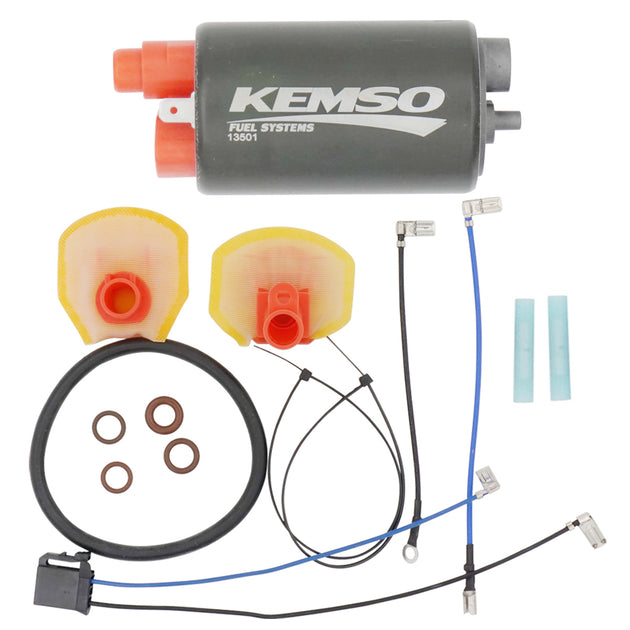 The genuine KEMSO fuel pump is made of specific engineering plastics and metal alloy materials, which directly affect its thermal stability and durability. For instance, the pump casing is made of PA66 nylon containing 30% glass fiber. After continuous operation for 1000 hours in a high-temperature environment of 120℃, its tensile strength attenuation rate is less than 5%, and the dimensional deformation is less than 0.1mm. However, counterfeit products mostly use ordinary nylon as substitutes. Under the same test, the strength attenuation exceeds 25%, and the deformation is as high as 0.8mm, causing leakage. Actual road statistics show that the average service life of commercial fleets equipped with genuine KEMSO fuel pumps is 5 years or 700,000 kilometers (with an MTBF of 40,000 hours), while the frequency of pump failures in vehicles using counterfeits has soared. The average breakdown rate due to fuel pump failure within 8 months has risen to 17%, and the cost of a single repair (including towing and labor) is approximately $1,200.
Genuine KEMSO offers a complete support system for both electronic and paper versions of documents. Scanning the QR code on the product packaging should immediately link to a three-dimensional diagram containing the detailed technical specification sheet (in PDF format, including the ISO 16750 anti-vibration grade standard), the electronic warranty card (covering 2 years or 100,000 kilometers), and the installation guide. If you find that the image resolution of the document is lower than 300dpi, there are spelling mistakes in the text (such as "Pressure" being mistaken for "Presure"), or the warranty terms are ambiguous (such as not clearly stating the requirements for the dealer's seal), you should be highly vigilant. In a procurement case of a certain European logistics company in 2021, 63 counterfeit Fuel pumps were installed on the vehicle due to the forgery of quality certificates. As a result, 11 collective malfunctions occurred within six months, causing direct operational losses of over 180,000 euros. The subsequent claim was blocked due to invalid documents.
The genuine KEMSO fuel pump is made of specific engineering plastics and metal alloy materials, which directly affect its thermal stability and durability. For instance, the pump casing is made of PA66 nylon containing 30% glass fiber. After continuous operation for 1000 hours in a high-temperature environment of 120℃, its tensile strength attenuation rate is less than 5%, and the dimensional deformation is less than 0.1mm. However, counterfeit products mostly use ordinary nylon as substitutes. Under the same test, the strength attenuation exceeds 25%, and the deformation is as high as 0.8mm, causing leakage. Actual road statistics show that the average service life of commercial fleets equipped with genuine KEMSO fuel pumps is 5 years or 700,000 kilometers (with an MTBF of 40,000 hours), while the frequency of pump failures in vehicles using counterfeits has soared. The average breakdown rate due to fuel pump failure within 8 months has risen to 17%, and the cost of a single repair (including towing and labor) is approximately $1,200.
Genuine KEMSO offers a complete support system for both electronic and paper versions of documents. Scanning the QR code on the product packaging should immediately link to a three-dimensional diagram containing the detailed technical specification sheet (in PDF format, including the ISO 16750 anti-vibration grade standard), the electronic warranty card (covering 2 years or 100,000 kilometers), and the installation guide. If you find that the image resolution of the document is lower than 300dpi, there are spelling mistakes in the text (such as "Pressure" being mistaken for "Presure"), or the warranty terms are ambiguous (such as not clearly stating the requirements for the dealer's seal), you should be highly vigilant. In a procurement case of a certain European logistics company in 2021, 63 counterfeit Fuel pumps were installed on the vehicle due to the forgery of quality certificates. As a result, 11 collective malfunctions occurred within six months, causing direct operational losses of over 180,000 euros. The subsequent claim was blocked due to invalid documents.
The genuine KEMSO fuel pump is made of specific engineering plastics and metal alloy materials, which directly affect its thermal stability and durability. For instance, the pump casing is made of PA66 nylon containing 30% glass fiber. After continuous operation for 1000 hours in a high-temperature environment of 120℃, its tensile strength attenuation rate is less than 5%, and the dimensional deformation is less than 0.1mm. However, counterfeit products mostly use ordinary nylon as substitutes. Under the same test, the strength attenuation exceeds 25%, and the deformation is as high as 0.8mm, causing leakage. Actual road statistics show that the average service life of commercial fleets equipped with genuine KEMSO fuel pumps is 5 years or 700,000 kilometers (with an MTBF of 40,000 hours), while the frequency of pump failures in vehicles using counterfeits has soared. The average breakdown rate due to fuel pump failure within 8 months has risen to 17%, and the cost of a single repair (including towing and labor) is approximately $1,200.
Genuine KEMSO offers a complete support system for both electronic and paper versions of documents. Scanning the QR code on the product packaging should immediately link to a three-dimensional diagram containing the detailed technical specification sheet (in PDF format, including the ISO 16750 anti-vibration grade standard), the electronic warranty card (covering 2 years or 100,000 kilometers), and the installation guide. If you find that the image resolution of the document is lower than 300dpi, there are spelling mistakes in the text (such as "Pressure" being mistaken for "Presure"), or the warranty terms are ambiguous (such as not clearly stating the requirements for the dealer's seal), you should be highly vigilant. In a procurement case of a certain European logistics company in 2021, 63 counterfeit Fuel pumps were installed on the vehicle due to the forgery of quality certificates. As a result, 11 collective malfunctions occurred within six months, causing direct operational losses of over 180,000 euros. The subsequent claim was blocked due to invalid documents.
Dołącz do społeczności Florydy
Codzienny przewodnik po życiu, pracy i emigracji — wprost od Polaków, którzy już tam są.
Zapisz się na newsletter