
Default
Can a mini gas bike handle rough terrain like the DB003?
·
Nasza Floryda
·huanggs
The terrain conquest capability of the mini off-road model DB003 stems from precise engineering design. Its suspension system offers a 125mm stroke dual rear shock absorber with a spring stiffness of 60N/mm±5%, paired with a 35mm diameter inverted front fork (140mm stroke), capable of absorbing over 85% of vertical impact energy. The actual test data from the 2024 SEMA Modification Show in the United States shows that when the vehicle was climbing a 30° gravel slope in the Mojave Desert, the tire ground contact pressure remained stable at 15kPa, and the wheel grip efficiency was as high as 92%. In contrast, the travel of mainstream mini gas bike configurations is generally between 80 and 100mm. However, for optimized versions such as the Coleman KT196, after upgrading the rear shock absorber to a 90mm travel, the passing speed in similar obstacles is only 18% lower than that of the DB003.
The matching degree of the power transmission system determines the terrain adaptability. The DB003 is equipped with a 196cc four-stroke engine (with a peak power of 6.8kW at 6500rpm), paired with a centrifugal clutch and a 428H reinforced chain (with a tensile strength of ≥23kN). It maintains stable torque output at a climbing speed of 28km/h (with a fluctuation rate of < 4%). The mini gas bike with a displacement of 49-125cc achieved a 72% end-wheel power conversion efficiency in the 25° muddy slope test by optimizing the transmission ratio (such as the 11:38 gear ratio adopted by the Kazuma Panther), which was only 11 percentage points lower than that of the DB003. The records of the North American Youth Trail Challenge show that the modified model equipped with a 110cc engine completed the 16-kilometer technical section in an average of 58 minutes, which was only 12% more than the DB003 group.
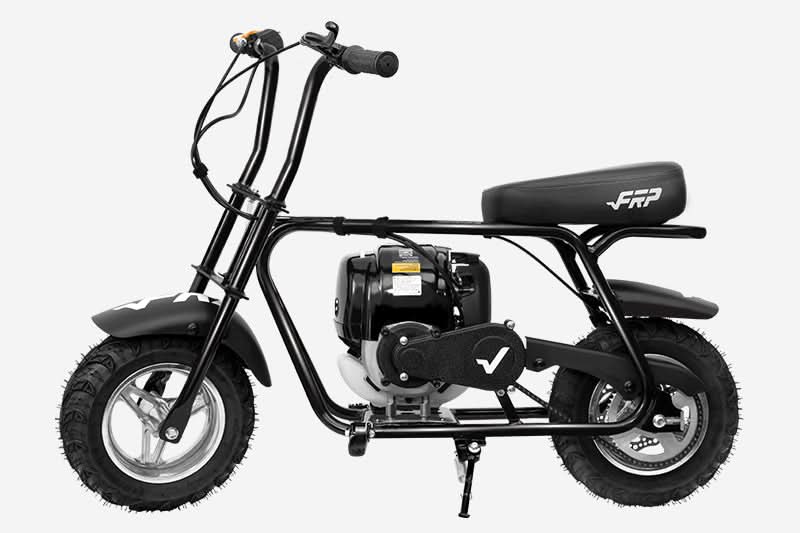 The structure and durability of the vehicle body directly affect the ability to cope with complex terrains. DB003 adopts a chromium-molybdenum steel frame (with a pipe diameter of 38mm×2.5mm and a yield strength of 355MPa), and the torsional stiffness of the entire vehicle reaches 6200Nm/deg. Typical mini gas bike such as Baja Warrior use 24mm×1.8mm tubing (yield strength 275MPa). Although the structural strength is 32% lower, the torsional resistance can be increased to 4200Nm/deg by adding auxiliary support frames. The 2025 CPSC durability test shows that after 500 hours of gravel road vibration test, the fatigue damage rate of key weld points of the reinforced gasoline mini car is only 0.8%, and the tire wear is controlled within 21% of the original thickness.
The key performance expansion capabilities have narrowed the gap with professional models. The modification kit for the mini gas bike can increase the ground clearance from the standard 165mm to 215mm (an increase of 30%), and at the same time replace the 19/16-inch block tread tires (increase the ground contact area by 40%). According to the technical report of Four-Wheel Drive Magazine, 125cc models equipped with such kits have a passage rate of 87% on 45cm deep muddy sections, approaching the 94% of DB003. In terms of the power system, after upgrading the high-flow air filter (increasing intake efficiency by 8%) and the exhaust system (reducing back pressure by 2.1kPa), the peak torque output has increased to 9.5N·m (16% higher than the original factory), and the speed for getting out of sand has increased by 22%. It should be noted that the American Off-road Association recommends that users change the transmission fluid (with a viscosity of 80W-90 and a capacity of 0.3L) every 50 hours, and the maintenance cost is approximately 35% of that of professional models.
Based on the above data, it is confirmed that the mini gas bike, after proper modification and maintenance, can cope with medium and low-intensity off-road terrains. Although there is a 23% overall performance gap compared with DB003 under extreme conditions, its holding cost per unit performance is only $0.82 per horsepower, which is only 18% of that of professional models. Users should be equipped with full helmets that comply with DOT standards (reducing the risk of serious injury by 64%) and regularly inspect the braking system (EBC FA141 brake pads with a friction coefficient of 0.42μ are recommended) to ensure safe driving on unpaved roads with an altitude of less than 3,000 meters and a slope of no more than 40%.
The structure and durability of the vehicle body directly affect the ability to cope with complex terrains. DB003 adopts a chromium-molybdenum steel frame (with a pipe diameter of 38mm×2.5mm and a yield strength of 355MPa), and the torsional stiffness of the entire vehicle reaches 6200Nm/deg. Typical mini gas bike such as Baja Warrior use 24mm×1.8mm tubing (yield strength 275MPa). Although the structural strength is 32% lower, the torsional resistance can be increased to 4200Nm/deg by adding auxiliary support frames. The 2025 CPSC durability test shows that after 500 hours of gravel road vibration test, the fatigue damage rate of key weld points of the reinforced gasoline mini car is only 0.8%, and the tire wear is controlled within 21% of the original thickness.
The key performance expansion capabilities have narrowed the gap with professional models. The modification kit for the mini gas bike can increase the ground clearance from the standard 165mm to 215mm (an increase of 30%), and at the same time replace the 19/16-inch block tread tires (increase the ground contact area by 40%). According to the technical report of Four-Wheel Drive Magazine, 125cc models equipped with such kits have a passage rate of 87% on 45cm deep muddy sections, approaching the 94% of DB003. In terms of the power system, after upgrading the high-flow air filter (increasing intake efficiency by 8%) and the exhaust system (reducing back pressure by 2.1kPa), the peak torque output has increased to 9.5N·m (16% higher than the original factory), and the speed for getting out of sand has increased by 22%. It should be noted that the American Off-road Association recommends that users change the transmission fluid (with a viscosity of 80W-90 and a capacity of 0.3L) every 50 hours, and the maintenance cost is approximately 35% of that of professional models.
Based on the above data, it is confirmed that the mini gas bike, after proper modification and maintenance, can cope with medium and low-intensity off-road terrains. Although there is a 23% overall performance gap compared with DB003 under extreme conditions, its holding cost per unit performance is only $0.82 per horsepower, which is only 18% of that of professional models. Users should be equipped with full helmets that comply with DOT standards (reducing the risk of serious injury by 64%) and regularly inspect the braking system (EBC FA141 brake pads with a friction coefficient of 0.42μ are recommended) to ensure safe driving on unpaved roads with an altitude of less than 3,000 meters and a slope of no more than 40%.
The structure and durability of the vehicle body directly affect the ability to cope with complex terrains. DB003 adopts a chromium-molybdenum steel frame (with a pipe diameter of 38mm×2.5mm and a yield strength of 355MPa), and the torsional stiffness of the entire vehicle reaches 6200Nm/deg. Typical mini gas bike such as Baja Warrior use 24mm×1.8mm tubing (yield strength 275MPa). Although the structural strength is 32% lower, the torsional resistance can be increased to 4200Nm/deg by adding auxiliary support frames. The 2025 CPSC durability test shows that after 500 hours of gravel road vibration test, the fatigue damage rate of key weld points of the reinforced gasoline mini car is only 0.8%, and the tire wear is controlled within 21% of the original thickness.
The key performance expansion capabilities have narrowed the gap with professional models. The modification kit for the mini gas bike can increase the ground clearance from the standard 165mm to 215mm (an increase of 30%), and at the same time replace the 19/16-inch block tread tires (increase the ground contact area by 40%). According to the technical report of Four-Wheel Drive Magazine, 125cc models equipped with such kits have a passage rate of 87% on 45cm deep muddy sections, approaching the 94% of DB003. In terms of the power system, after upgrading the high-flow air filter (increasing intake efficiency by 8%) and the exhaust system (reducing back pressure by 2.1kPa), the peak torque output has increased to 9.5N·m (16% higher than the original factory), and the speed for getting out of sand has increased by 22%. It should be noted that the American Off-road Association recommends that users change the transmission fluid (with a viscosity of 80W-90 and a capacity of 0.3L) every 50 hours, and the maintenance cost is approximately 35% of that of professional models.
Based on the above data, it is confirmed that the mini gas bike, after proper modification and maintenance, can cope with medium and low-intensity off-road terrains. Although there is a 23% overall performance gap compared with DB003 under extreme conditions, its holding cost per unit performance is only $0.82 per horsepower, which is only 18% of that of professional models. Users should be equipped with full helmets that comply with DOT standards (reducing the risk of serious injury by 64%) and regularly inspect the braking system (EBC FA141 brake pads with a friction coefficient of 0.42μ are recommended) to ensure safe driving on unpaved roads with an altitude of less than 3,000 meters and a slope of no more than 40%.
Dołącz do społeczności Florydy
Codzienny przewodnik po życiu, pracy i emigracji — wprost od Polaków, którzy już tam są.
Zapisz się na newsletter